
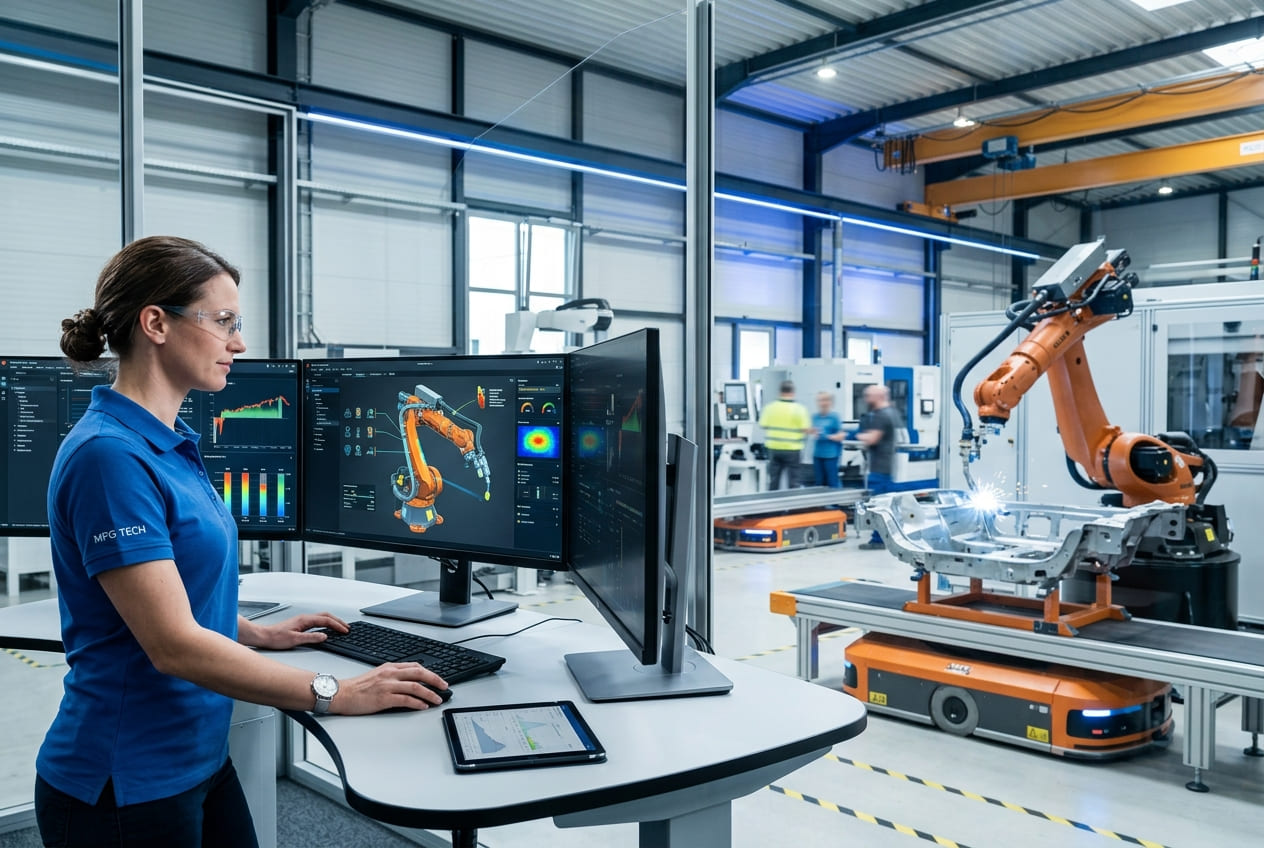
Manufacturing has long relied on physical prototypes, reactive maintenance schedules, and gut-feeling forecasts to keep production lines moving. That old approach, a time-wasting whirlpool of trial-and-error and costly downtime, is rapidly giving way to something far more intelligent. Digital twins are virtual replicas of physical assets, processes, or entire factories that mirror real-world behavior in real time. They allow manufacturers to test, predict, and refine operations before committing a single dollar to physical changes.
As we look toward 2025 and 2026, the most remarkable manufacturers (the Purple Cows in a sea of sameness, as Seth Godin might say) will be those who treat digital twin technology not as a novelty but as a core strategic asset. The range of digital twin manufacturing use cases now spans product design, predictive maintenance, supply chain management, and even carbon footprint monitoring. This article examines the most impactful of those applications and explains why they matter for your bottom line, your operational resilience, and your competitive differentiation. Whether you run a single production facility or oversee a global network of plants, understanding these use cases positions you ahead of the curve rather than behind it.
Evolution of Digital Twins in Industry 4.0
The concept of a digital twin is not new. NASA used rudimentary virtual models of spacecraft in the 1960s to simulate mission scenarios. What has changed is the convergence of affordable sensors, cloud computing, and machine learning that makes digital twins practical for everyday manufacturing. Industry 4.0 treats the factory as a connected ecosystem where data flows freely between machines, software platforms, and human operators. The digital twin sits at the center of that ecosystem, translating raw data into decisions.
Bridging the Physical and Virtual Worlds
A digital twin is only as valuable as its fidelity to the physical asset it represents. Modern twins achieve this fidelity through continuous synchronization: every vibration, temperature reading, and throughput metric from the shop floor is reflected in the virtual model within seconds. This is not a static 3D rendering. It is a living, breathing replica that ages, degrades, and responds to environmental changes just as the real asset does. For manufacturers, this bridge between physical and virtual worlds means you can run “what if” scenarios (with full confidence in the results) without halting production or risking equipment.
Real-Time Data Integration via IoT Sensors
IoT sensors are the nervous system of any digital twin deployment. Accelerometers on rotating equipment, thermal cameras on furnaces, and flow meters on chemical lines all feed data into the twin. The old way involved periodic manual inspections, a spray-and-pray methodology where problems were discovered only after they caused downtime. Real-time integration changes that equation entirely. By 2026, Gartner estimates that over 50% of large industrial enterprises will use digital twins powered by IoT data to improve operational effectiveness by at least 10%. Your sensor strategy, including placement, frequency of readings, and data pipeline architecture, directly determines the accuracy and usefulness of the twin.
Optimizing Product Design and Prototyping
Physical prototyping is expensive, slow, and wasteful. A single injection-mold tool revision can cost tens of thousands of dollars and add weeks to a project timeline. Digital twins offer a fundamentally different path.
Virtual Testing and Stress Simulation
Rather than building a physical part and subjecting it to destructive testing, engineers can apply virtual loads, thermal cycles, and fatigue scenarios to a digital twin of the component. Finite element analysis (FEA) integrated with twin models lets you identify weak points before a single gram of material is consumed. Automotive manufacturers like BMW already use this approach to test crash performance on virtual vehicle bodies, reducing the number of physical crash tests by roughly 30%. The result is not just cost savings. It is faster learning cycles that compound over time.
Accelerating Time-to-Market with Digital Iterations
Speed is a Purple Cow trait. Companies that bring validated products to market faster capture share and set pricing expectations. Digital twins compress the design-test-refine loop from months to days. An engineer can modify a turbine blade geometry at 9 a.m., run a full aerodynamic simulation by noon, and share validated results with the production team before the end of the day. This rapid iteration eliminates the back-and-forth between design and manufacturing that has historically plagued new product introductions. For your 2025 product roadmap, consider how many weeks you could reclaim by shifting even 50% of physical prototype cycles to virtual ones.
Enhancing Operational Efficiency and Maintenance
Once a product is in production, the focus shifts to keeping machines running and processes flowing. This is where manufacturing use cases for digital twins deliver some of their most measurable returns.
Predictive Maintenance and Asset Lifecycle Management
Reactive maintenance, fixing things after they break, is the most expensive maintenance strategy. Preventive maintenance, servicing on a fixed schedule regardless of condition, is better but still wasteful. Predictive maintenance, powered by digital twins, is the new standard. The twin monitors real-time sensor data against historical degradation patterns and physics-based models to forecast exactly when a bearing, motor, or seal will fail. Siemens reports that predictive maintenance enabled by digital twins can reduce unplanned downtime by up to 50% and extend asset life by 20-25%. You are not just avoiding breakdowns. You are managing the full lifecycle of every critical asset with precision.
Workflow Simulation and Bottleneck Identification
Beyond individual machines, digital twins can model entire production lines or factory layouts. This allows you to simulate workflow changes before implementing them physically:
-
Rearranging workstation sequences to reduce material handling time
-
Testing the impact of adding a second shift versus investing in automation
-
Identifying the single constraint (the bottleneck) that limits overall throughput
These simulations replace expensive and disruptive physical trials. A food manufacturer, for example, might discover through twin simulation that a packaging station, not the filling line, is the true constraint. Fixing the right problem first saves both time and capital.
Supply Chain Visibility and Inventory Control
The manufacturing floor does not exist in isolation. Raw materials flow in, finished goods flow out, and disruptions at any point ripple through the entire value chain. Digital twins applied to supply chains offer a level of visibility that spreadsheets and ERP dashboards alone cannot match.
End-to-End Logistics Tracking
A supply chain digital twin aggregates data from suppliers, freight carriers, warehouses, and customs systems into a single virtual model. You can see where every shipment is, predict arrival times based on real conditions (weather, port congestion, carrier performance), and reroute proactively when disruptions occur. This is not theoretical. Unilever has deployed supply chain twins across its global network to reduce logistics costs and improve delivery reliability. The old approach of waiting for a delayed shipment notification and then scrambling to respond is replaced by anticipatory action (with ethical sourcing considerations built into the model, of course).
Dynamic Demand Forecasting Models
Traditional demand forecasting relies on historical sales data and seasonal patterns. Digital twins augment this with real-time signals: point-of-sale data, social media sentiment, weather forecasts, and even competitor pricing changes. The twin continuously recalibrates its demand predictions, allowing you to adjust production schedules and inventory levels dynamically. For manufacturers dealing with perishable goods or short product lifecycles, this capability is the difference between profitable operations and chronic overstock or stockout situations. By 2030, expect dynamic twin-driven forecasting to become the baseline expectation rather than a competitive advantage.
Future Trends in Cognitive Digital Twins
The next generation of digital twins will not simply mirror the physical world. They will reason about it, make autonomous decisions, and help manufacturers meet sustainability goals that regulators and consumers increasingly demand.
AI-Driven Autonomous Decision Making
Cognitive digital twins integrate machine learning models that learn from every operational cycle. Over time, these twins move from descriptive (“here is what happened”) to prescriptive (“here is what you should do”). Imagine a twin that detects an emerging quality defect pattern, identifies the root cause as a temperature drift in a heat treatment furnace, and autonomously adjusts the setpoint before a single defective part is produced. This level of autonomy requires trust, validation, and guardrails (no manufacturer should hand full control to an algorithm without rigorous testing), but the trajectory is clear. By 2026, early adopters will demonstrate measurable quality and throughput gains from autonomous twin-driven decisions.
Sustainability and Carbon Footprint Monitoring
Sustainability is becoming a non-negotiable business requirement, not merely a marketing talking point. Digital twins can model the energy consumption and carbon emissions of every process step, from raw material extraction to finished product shipment. This granular visibility lets you identify the highest-impact reduction opportunities. A steel manufacturer might discover that 40% of its carbon footprint comes from a single reheating furnace and then use the twin to test alternative fuel mixes or process configurations virtually before committing capital. Scope 3 emissions tracking, covering your entire supply chain, becomes feasible when twin models extend beyond your factory walls.
Where Digital Twins Take Manufacturing Next
The use cases covered here, from product design simulation to carbon monitoring, represent the current frontier. But the real power of digital twins in manufacturing lies in their compounding effect. Each new data source, each refined model, and each validated prediction make the twin smarter and more valuable. Manufacturers who begin building their twin infrastructure now will have years of accumulated intelligence by 2030, a moat that late adopters will struggle to cross.
Your next step is straightforward: identify one high-value asset or process where downtime or inefficiency costs you the most. Build a digital twin for that single use case. Measure the results. Then expand. The Purple Cow manufacturers of the next decade will not be those with the largest factories or the lowest labor costs. They will be the ones whose virtual replicas of the physical world are so accurate, so intelligent, and so deeply integrated into decision-making that the twin becomes inseparable from the operation itself. That is the remarkable difference worth pursuing.




Leave A Comment